Io sono il ritratto del sole

Il sole splende
Ciao,
Mi chiamo Sole.
Splendo su tutti
Chi vede la luce?
© Yelling Rosa
19/9 –22
You can comment on each article for ten days after it is published.




Ciao,
Mi chiamo Sole.
Splendo su tutti
Chi vede la luce?
© Yelling Rosa
19/9 –22
You can comment on each article for ten days after it is published.
My sun is shining on you
Whom people hate
Like they hate me.
Our destiny is to exist
Even nobody likes us.
Still, without you and me
The world wouldn’t
Be perfect.
© Yelling Rosa
9/9 –22
I hope that the poem above serves as an introduction to what I will say below. Nobody can be someone else.
Dear Readers I am all right
Don’t feel sorry for me but help those who are now in the group mangle. I use myself and my experiences to make the subject alive.
My whole life has been very challenging for me. It has been challenging for others, too, because they have often found something to blame me. Because I had been the only odd in the group, I started to think something was wrong with me. To improve things, I have tried to change myself into something else. Now, at 70, I have finally realized that it is impossible and unnecessary. In a nutshell: Diversity makes perfect.
You may wonder why I am saying that the blamed one has also done something wrong automatically. Yes, the blamed one has forgotten to defend and love himself. The reasons for that mechanism vary greatly. This range of reasons makes analyzing problem situations difficult and often even impossible. Moreover, there is always more than one person who are making analyzes.
The key to the door of clarity is inside every individual. If somebody’s behavior irritates you, you must look at yourself in the mirror. Most likely, the same things don’t annoy others. If you are the blame, you must look around and compare how people generally take up you. In most cases, this method is enough to give a tool to protect yourself.
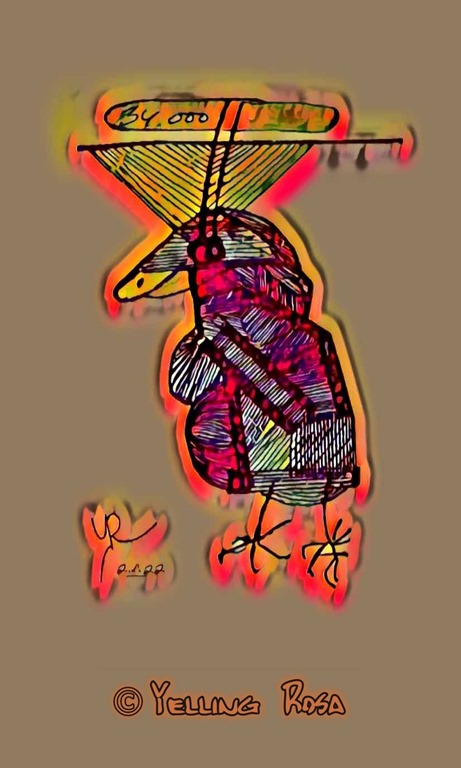
This rooster loves himself even though he doesn’t want to bully the hens.
He went to the farmer and asked him to let him be himself. The farmer was a lovely man, and now our rooster doesn’t have to be a teaser any more. The hens have also started to accept him.
Why don’t you do the same thing?
Sometimes, as happened to me, most people found faults and shortcomings in me. I didn’t know anything else than try to make myself better me. Even though I made progress, people found something to say about my acts and behavior. The situation has been like this almost up here where I am now. Now I realize that the reason for the blames is my inner personality. It doesn’t appeal to most people. Even now, when I think I have made wrong conclusions and must keep educating myself, I tell myself that even Jesus fell into the clutches of men.
People are small group animals. That’s why they build the groups around them. The group members isolate the unsuitable persons from the circle. In borderline cases, the group tries to train the individual so that she would be suitable after being brainwashed. In families, retraining is necessary because an unsuitable individual is entitled to join the group based on her bloodline.
The biggest dramas are born in families because we can not pan the unsuitable member. The discriminated members submit to their fate or start to fight for their rights. Both of these options are risky. Submission almost inevitably leads to mental breakdowns, even suicides, and fighting can lead to violence. Of course, sometimes, the result can be positive. The other family members start to respect the fighter, and they see that we must treat the depressed member gently.
I have tried to fight, but all my new solutions were the reason to blame me more. My aggression is proof of my ineligibility. After that, parallel fighting, I try to be a better person than I am. As I already mentioned, nothing has changed. Even so, not very long ago, after explaining my exceptional sensitivity by letter, the receiver said I was bragging to him.
Shortly, even this state of better self-understanding is not acceptable.
After fighting against the windmills for almost 70 years, I have decided to live alone or only with those whose company I enjoy and vice versa. Now and then, I find myself guilty about the state of my life. Then I say to myself you tried 70 years only to understand that you can’t be anything than yourself. If someone doesn’t feel comfortable in my company, that’s their concern, as I greatly like myself.
You can get out of the circle because of different reasons. The most important thing is that you never stop loving yourself. Of course, some people must improve their behavior after committing crimes. But many crimes can prevent in advance when we love ourselves in time. Because more than one person is blaming the one who is not suitable for the group, the isolated person must be in balance with herself. If you need to make yourself better, make your love stronger.
I have seen many bloggers thinking about proving themselves or the neighborhood, perhaps both. Sometimes this might be the key to the door of clarity, but don’t try this too long. I tried to be someone else for almost 70 years. Now, I don’t have much time to wander on earth when I am in balance. Sometimes I am unfortunate because of this loss but happy that I have seen the light. And most of everything, I hope that everyone else could be their whole lives themselves or if they are in the mangle, they get through earlier than me.
Dear Readers I am all right
Don’t feel sorry for me but help those who are now in the group mangle. I use myself and my experiences to make the subject alive.


There is a saying in Finland that the cock of honor either crows or does not crow. This saying depends on whether we perform the task well or poorly. Usually, we use the phrase negatively, meaning that someone will face difficulties because of what he has done.
Below you see my Cock of Honor.
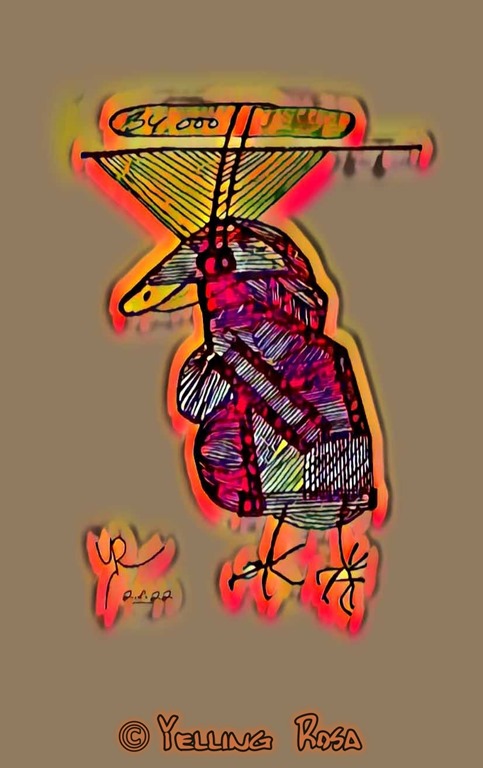
The cock on the drawing is the positive one. The bird has a 34.000 euros aura above his crest. Why is he honorable? He has earned his money by being himself.
Spruce Branch Crown

You can comment on each article for ten days after it is published.


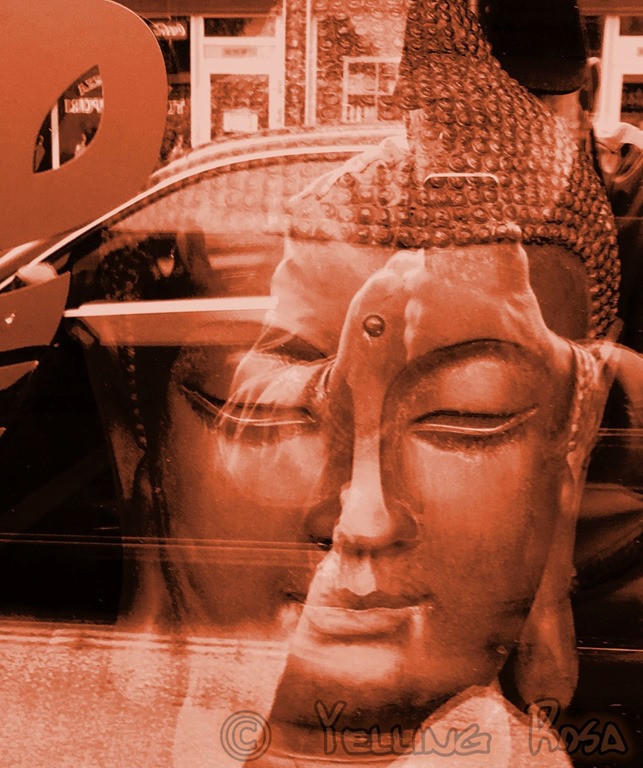
I met the Buddha,
When I was on my way
To an ophthalmologist.
We changed news.
He is a nice fellow.
© Yelling Rosa
10/8 –22

Tapasin Buddhan,
kun olin matkalla
silmälääkärille.
Vaihdoimme
kuulumisia.
Hän on mukava
kaveri.
© Yelling Rosa
10/8-22

The madman got on the bus.
He tried so hard to hide his madness,
That it already looked crazy.
He got off the bus
Many stops before the hospital,
But didn’t make anyone think
That he is not a resident of the sanatorium.
The following day a mental hospital nurse
Came to my cabin and asked if I had seen a person
Whose characteristics match the man I saw on the bus.
The nurse gave me a pack of cigarettes
And urged me to offer smoke to him.
Then he will sit down
And tells his dark story
As long as there are
Cigarettes.
Meanwhile phone us
And we got plenty
Of time to come
And catch him.
The runaway hero didn’t make it to ten
Smoke before the staff
Drove a car in my yard
The nurse told me
That the patient was unauthorized
On a bus trip also,
But returned himself
To the hospital.
© Yelling Rosa
13/8 -22
And this is a true story from the sixties of a runaway hero,
who wasn’t dangerous but a pain in the butt of the mental institution.


I am going to gather my finger exercises of Latino Sine Flexionen here. I know that my time left is too short to get the perfect rip of it, but in this manner, the time I am using studying Sine Flexione won’t run into the drain. These studies help me to learn more English as well.
PLEASE DON’T CORRECT ME!!! It would be a waste of time to start to rewrite sentences. We learn by making mistakes, and when we are allowed to do them, we get along with what we are doing better. Giuseppe Peano’s instructions on formatting Sine Flexione from Latin are very weak. By following them, we are not able to form an enjoyable language.
You find Peano’s instructions at https://acproil.github.io/pdf/grammatical-notes.pdf
Interlingua is Sine Flexione’s variation.
Tu et altero calamitates naturale
ambula in silvas et inquina prospectu.
Si aliquo vitupera nos,
nos respondere:
Iste es processu,
praestantia de
homines.
© Yelling Rosa
3/8 –22

Det är sant att du hade ett hårt liv,
men en sak du har haft mera än jag.
Du hade möjlighet att leva
i ditt fosterland, i Karelia,
varifrån min hela släkt jakades bort
av den röda brutala armén,
samma armé som vandaliserar
i Ukraina idag.
Jag skall aldrig finna fred för min själ
som snart återkomma hem i Karelia.
Kanske vi kan hålla varandra sällskap
och promenerar tillsammans
vid stranden av Finska viken,
plockar upp smultron i skogen
som min mamma gjorde.
Och en vacker dag ska vi gå till Petersburg, eller hur,
var min mormor född och visiterar
utanför hennes skola, kanske samma skol
som du har gått på.
Mellantid när jag är still på väg
du kan sitta på din trädgårdssoffa
och solar sig med ett litet brev
av längtan i barmen.
© Yelling Rosa
29/7–22
You indeed had a hard life,
But one thing, you have had more than me.
You had the opportunity to live
In your homeland, in Karelia,
From where my whole family was chased away
By the brutal red army,
The same military that vandalizes
In Ukraine today.
I shall never find peace for my soul
That will soon return home to Karelia.
Maybe we can keep each other company
And walk together on the shores of the Gulf of Finland,
Picking up strawberries in the forest
Like my mother did.
And one day we’ll go to Petersburg, won’t we,
Where my grandmother was born
And visit outside her school,
Maybe the same school
You have attended.
Meanwhile when
I’m still on the road
You can sit on your garden sofa
And bask with a little letter
Of longing in the bosom.
© Yelling Rosa
29/7–22
I have read Edith Södergran’s poems all my life because I have experienced her as my kindred spirit. In my poem, ”Ett litet brev av längtan” I refer to Edith’s ballad ”En önskan” where she talks about her dream, just one small letter. Of course, it is my interpretation the letter speaks about the longing for a soulmate. Besides, I have not made my conclusion based only on that poem but on her entire production.
|
En önskan |
A Wish |
|
Av hela vår soliga värld |
From our sunny world |
|
önskar jag blott en trädgårdssoffa |
I want only a garden sofa |
|
där en katt solar sig … |
where a cat basks… |
|
Där skulle jag sitta |
There I would sit |
|
med ett brev i barmen, |
with a letter by my breast, |
|
ett enda litet brev. |
a tiny, short letter. |
|
Så ser min dröm ut… |
Such is my dream… |
|
Edith Södergran |
Edith Irene Södergran (4 April 1892 – 24 June 1923) was a Swedish-speaking Finnish poet who lived and died in the village of Raivola on the Karelian Isthmus. The village of Raivola is very close to the spa town of Terijoki, where my family had a summer villa. Read more about Edith.
Karelia became part of the Soviet Union in 1944. The Soviet Union invaded Finland in 1939.
You can comment on each article for ten days after it is published.
Kysymys,
ei ole menemisestä
tai tulemisesta
vaan olemisesta.
© Yelling Rosa
1987

Question,
is not about departing
not about arriving;
the question
is to be.
© Yelling Rosa
1987

Hunt down the question,
Because the answer
Is not blowing in the wind
But nested in your mind.
© Yelling Rosa
20/7 –22

You can comment on each article for ten days after it is published.


I drew this picture tonight, 9 July 2022.

I got the name ”A Mad Merry-go-round” from one comment on my blog.
You can comment on each article for ten days after it is published.


I never really learned anything,
For remembering had not been my thing.
Now that I’m dragging out the last years,
Recollection is even worse.
People strive from different points,
But we measure one other by the same yardsticks.
There are no different weight categories among people.
Everyone runs the same track, and the best talents at birth
for free received ones are winning.
© Yelling Rosa
6/7 –22
Same Competition with Different Features © Yelling Rosa -22
Here in Finland, many influencers have said there is only room for one fact at a time. However, I’m afraid I have to disagree. I think the world can only fit one lie at a time, which gains a foothold by repeating it endlessly.Lately, the world has always been one rainbow to such an extent that you might think there are no heterosexuals in this world. When we forget facts, truths lose their meaning.
We simplified bullying to a level where only nasty bullies persecute good individuals. This simplification has resulted in reverse bullying. In television programs, school bullies are called idiots and incite contempt toward the bullies. The promulgators of these insults completely forget that the bullies are almost always bullied. They learn to tease because someone has teased them. The most important thing has not even received a secondary role in simplifying the causes of bullying. We live in a competitive society where rising above others is considered a desirable endeavor. No matter how positive their gifts are, elevating the few above the rest is frowned upon by people outside the podium.
This glorification of the most successful individuals is both short-sighted and unfair. The truth is that the individual has not done anything to have some glorified qualities, such as good looks, an accurate ear for music, lots of fast muscles, and so on. Humans get their natural gifts at birth. It has been studied, for example, that a person can increase his running speed by a maximum of 10 percent through his efforts. On the other hand, you can’t get an absolute pitch by practicing, but it comes in mother’s milk if it is to come.
© Yelling Rosa
You can comment on each article for ten days after it is published.


The English version of this article after the Finnish version
Helka Riionheimo,
Suomen kielen professori
Itä-Suomen yliopisto
Ilkka Pakarinen,
Kirjoittelija,
Lapin maakunta
Hei,
Haluaisin tietää, onko suomalaiset ja suomensukuiset kielitieteilijät ajatelleet kehittää yhteistä kieltä kaikille ugrilaisille kansoille. Monet sukukielet ovat kuolemassa ja samalla sukukansojemme kulttuuri.
Israelissa elvytettiin jo kuollut hebrean kieli ja se elää kukoistuksen kautta. Tämä oli siellä tietysti välttämätöntä, koska juutalaisilla ei ollut yhtä valtakieltä, josta pystyi rakentaa identiteettiä.
Tietysti modernin kantauralin kehittäminen olisi haasteellista, koska esimerkiksi unkarin kieli on kulkeutunut hyvin kauas itämerensuomalaisista kielistä. Tämän tosiasian vuoksi yhteinen kieli voisi jakaantua kahteen linjaan moderniin kantauralin ja modernin kantasuomen kehittämisiin.
Tietysti monet pienten kielikuntien puhujat vastustavat tällaista ajatusta, mutta jos ollaan rehellisiä, niin oman identiteetin löytyminen tällaisen kielen kautta olisi varminta. Jos ajatellaan esimerkiksi karjalan kieltä, se on kieli, johon on sekoittunut venäjän kieltä, suomen kieli on ruotsin kielen ja viro saksan kielen saastuttamaa jne. Mitä omaa tällainen on?
Kaikkiin kieliin tietysti tulee sanoja toisista kielistä, mutta silti suomalais-ugrilaiset kielet ovat rakenteellisesti muuttuneet vuosituhansien aikana yllättävän vähän. Näin tätä kannattaa miettiä.
Terveisin
ilusamuli
alias Yelling Rosa,
kirjoittelija
https://yellingrosa.com/wordpress/
Miä uon vain tällai kirjottuja,
mut mius elläö urralmiel.
Se vuatii tulha esih
ja pajattua Urral
kansaih kelel.
© Yelling Rosa
Tul täs mielhe –runo on karjalan murretta, karjalan kieltä ja inkeroisen kieltä, mitkä on keitetty samassa padassa ja hämmennetyt perusteellisesti. Näin on saatu aikaan kielinäyte, joka ei oikeastaan ole mitään olemassa olevaa kieltä.

The Flag of Ugrians
There are over 23 million people who speak the Ugric languages.
The most remarkable groups are Hungarians, over 14 million, Finnish, around 5.5 million, and Estonians, over 1 million.
This is a letter to professor Helka Rionheimo:
Hi,
I would like to know whether Finnish linguists have considered developing a common language for all Ugric peoples. Many tribal languages are dying, and at the same time, the culture of our tribes.
The already dead Hebrew language was revived in Israel and is living through prosperity. To wake up in Hebrew was necessary because the Jews did not have a single language from which to build an identity.
Of course, developing a modern proto-language would be challenging because Hungarian, for example, has moved very far from the Baltic Finnic languages. Because of this, linguists could divide the common language into developing lines in the modern proto-Uralic and proto-Finnic development.
Of course, many speakers of minor languages oppose such an idea, but to be honest, finding one’s own identity through such language would be a guarantee. If we think of the Karelian language, for example, it is a language mixed with Russian, Swedish has contaminated Finnish, German has contaminated Estonian, etc. What is this?
Of course, words from other languages will appear in all languages, but Finno-Ugric languages have changed surprisingly little over the millennia. The standard modern Finno-Ugric language is something to consider for all Ugric people.
Regards
ilusamuli
alias Yelling Rosa,
author
https://yellingrosa.com/wordpress/
Miä uon vain tällai kirjottuja,
mut mius elläö urralmiel.
Se vuatii tulha esih
ja pajattua Urral
kansaih kelel.
© Yelling Rosa
25/6 -22
Tul täs mielhe poem is a mixture of the Karelian dialect, the Karelian language, and the language of the Ingrian, which I have cooked in the same pot and thoroughly stirred. This language soup is the result of no existing living language.
Just Pop in My Mind (Tul täs mielhe)
I am just an unknown writer
but inside of me lives the mind of Ugrians.
This spirit demand to come into the air of humans
and speak in the language of Uralic people.
© Yelling Rosa
25/6 –22
Read the Estonian World article about the subject. This article tells that Finno-Ugric peoples are the indigenous people of Europe. Before the migration period, Finno-Ugric languages were the main languages in Eastern Europe. The linguistic relations between all Finno-Ugric peoples were discovered by the Hungarian scholar, János Sajnovics (1733-1785).

This map is from Wikimedia.org
You can enlarge it by clicking on it.

