
A translation engine developed by the NLP research group of the University of Tartu. While there are many other machine translation solutions available online, our work focuses primarily on languages that play an important role in our region, including many Finno-Ugric languages with smaller speaker communities and dialects not supported by other machine translation solutions. Read more about machine here.
Below is the user interface of Neurotõlge
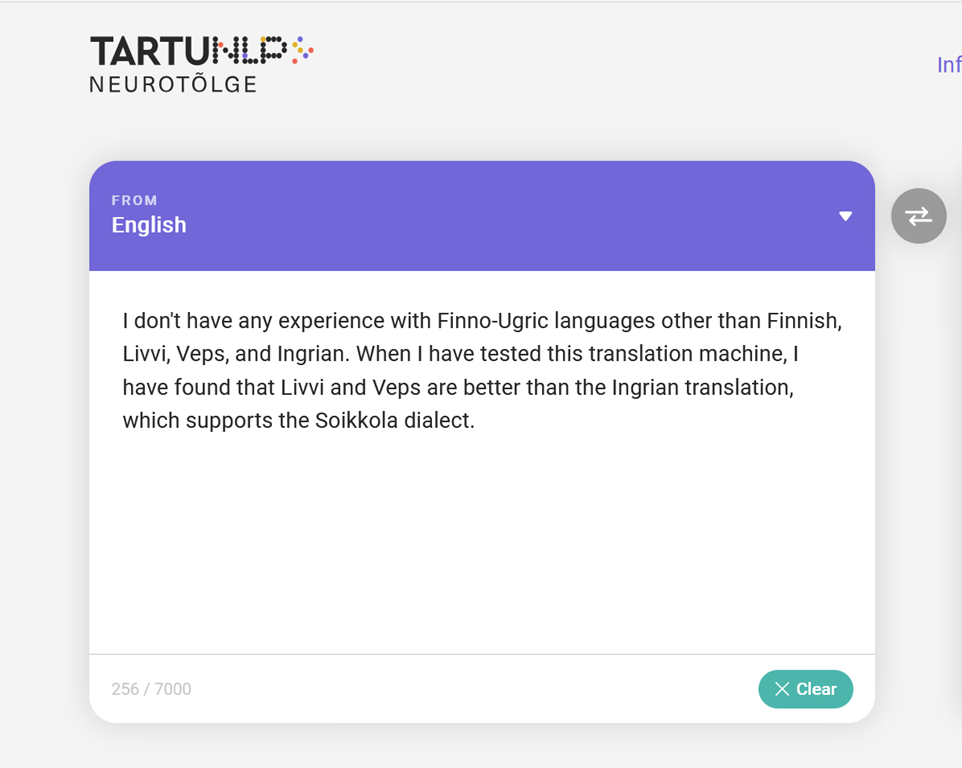
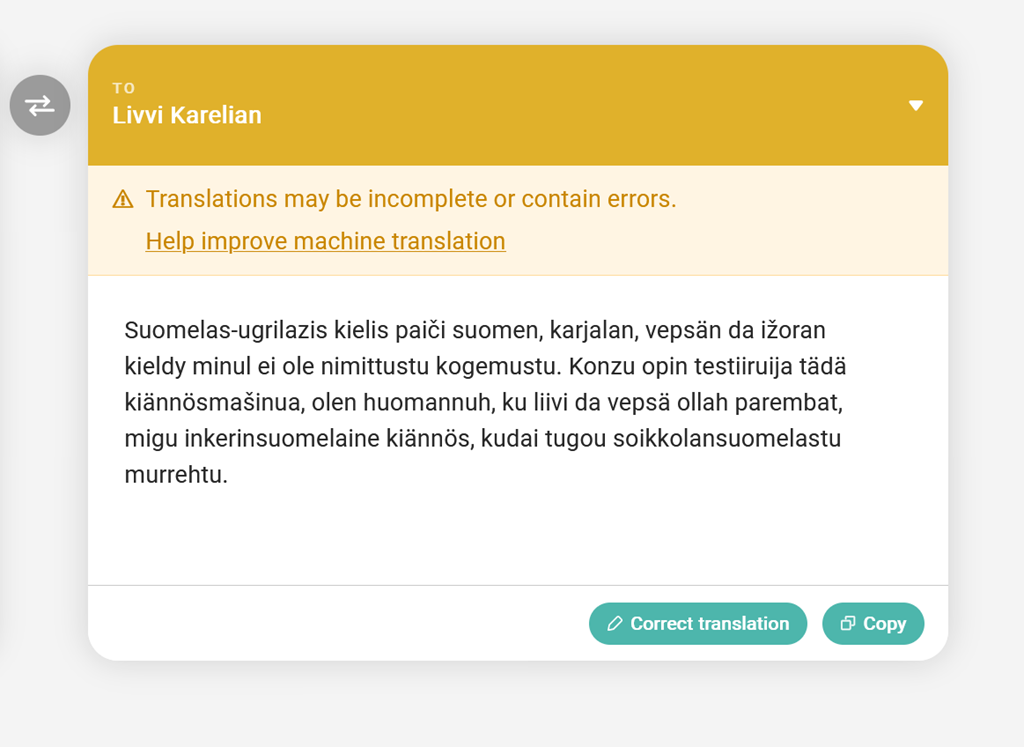
Below are three sentences I have translated from the Livvinkarjalan kielioppi (The Grammar of Livvi) in Finnish and Ingrian.
| Livvi | Finnish | Ingrian |
|---|---|---|
| Ukonvemmel nägüü vihman jälles, 82. | Sateenkaari näkyy sateen jälkeen. |
Vihmakarre näkkyy vihman jäles. |
| Egläi oli vilu päivä, 53. | Eilen oli kylmä päivä. |
Egle oli viluin päivä. |
| Keräin kaheksa litrua must’oidu, 62. | Poimin kahdeksan litraa mustikkaa. |
Korjaisin kahesa litraa mussikkaa. |
Then the same sentences are translated by Neurotõlge
| Finnish | Livvi | Ingrian |
|---|---|---|
| Sateenkaari näkyy sateen jälkeen. | Sateenkaari nägyy vihman jälles. | Per̆rää vihman lḙḙnöö vihma-kaari |
| Dictionary doesn’t know the word ”Sateenkaari”. | Leenöö = third-person singular future/potential of olla => to be. This sentence says that after the rain there might be a rainbow. |
|
| Eilen oli kylmä päivä. |
Egläi oli vilu päivy. | Egle oli külmä päivä. Külmä = viluin |
| Poimin kahdeksan litraa mustikkaa. |
Keräin kaheksa litrua buolua.
Buolu = lingonberry (cowberry)
|
Miä korjaižin kaheksa lit̆taada muššigaišt.
Mussikkain = mussikka,
I haven’t see the word ”littaada” which is most likely the partitive case from some word like ”litta”. Litra word I have seen Ingrian textbooks. |
The challenge with the Ingrian language is that there is no literary form. I myself rely on the ”Dictionary of the Ingrian Dialects” edited by R. E. Nirvin. The book contains words from all over Ingria. Wikitionary has apparently adopted the spelling from Väinö Junus, who created the Ingrian literary language. Some writings say that Junus created the literary language, and others claim that there is no literary language.
For me, the question is clear. I write as my grandmother spoke. She spoke a dialect other than Soikkola. I never asked when she was still around. On the other hand, I have wondered whether the people living in Ingria had a lingua franca. AI mentions the dialect of Finnish used by the people living in Ingria. It is difficult to say what the question is because language people focus only on the Soikkola dialect, which is by no means the only dialect of Ingria.
I have downloaded folktales recorded in Soikkola over the decades from the internet, which are written in a completely different style from the language in which they are written, as translated by Neurotõlge.
Ingrian language
From Wikipedia, the free encyclopedia
Not to be confused with the Ingrian dialects.
Ingrian (inkeroin keeli, Soikkola: [ˈiŋɡ̊e̞roi̯ŋ ˈke̝ːlʲi]), also called Izhorian (ižoran keeli, Soikkola: [ˈiʒ̥o̞rɑŋ ˈke̝ːlʲi], Ala-Laukaa: [ˈiʒo̞rəŋ ˈkeːlʲ]), is a Finnic language spoken by the (mainly Orthodox) Izhorians of Ingria. It has approximately 70 native speakers left, most of whom are elderly.[1][2][5]
The Ingrian language should be distinguished from the Ingrian dialect of the Finnish language, which became the majority language of Ingria in the 17th century with the influx of Lutheran Finnish immigrants; their descendants, the Ingrian Finns, are often referred to as Ingrians. The immigration of Lutheran Finns was promoted by Swedish authorities, who gained the area in 1617 from Russia, as the local population was (and remained) Orthodox.
Read the rest if the article here.
PS My grandmother was Orthodox.